- Typical cause
- A supply or drain line, a roof or roof drain failure, sprinkler discharge, or a leak from the unit above.
- First move
- Isolate the water, keep people out of wet or electrically uncertain areas, and notify building management.
- Not included
- Reconstruction, sprinkler system service and roof repair are separate scopes.
The first four decisions
Commercial losses follow the same physics as residential ones with more people involved. The first hour comes down to four decisions: where the water comes from and how to isolate it, which areas are electrically unsafe, who is allowed in, and what can be moved out of harm’s way.
- Shutoff. Find the branch valve for the affected area before looking for the main. Tenant spaces often have one. If not, the building engineer or manager closes a riser or the main. A sprinkler discharge is different: it needs the fire protection contractor and the fire department’s guidance.
- Electrical safety. Light fixtures, floor boxes and equipment can be energized under a wet ceiling. Do not touch them.
- Access. Keep staff and customers out of wet and sagging-ceiling areas. Wet tile and polished concrete are slip hazards.
- What to protect. Lift or relocate inventory, records and electronics when it can be done safely.
Say how many units or rooms are wet, what the space is used for and whether the source has been shut off.
Offices, retail units, restaurants and warehouses differ
| Property | Where water goes | What slows the job down |
|---|---|---|
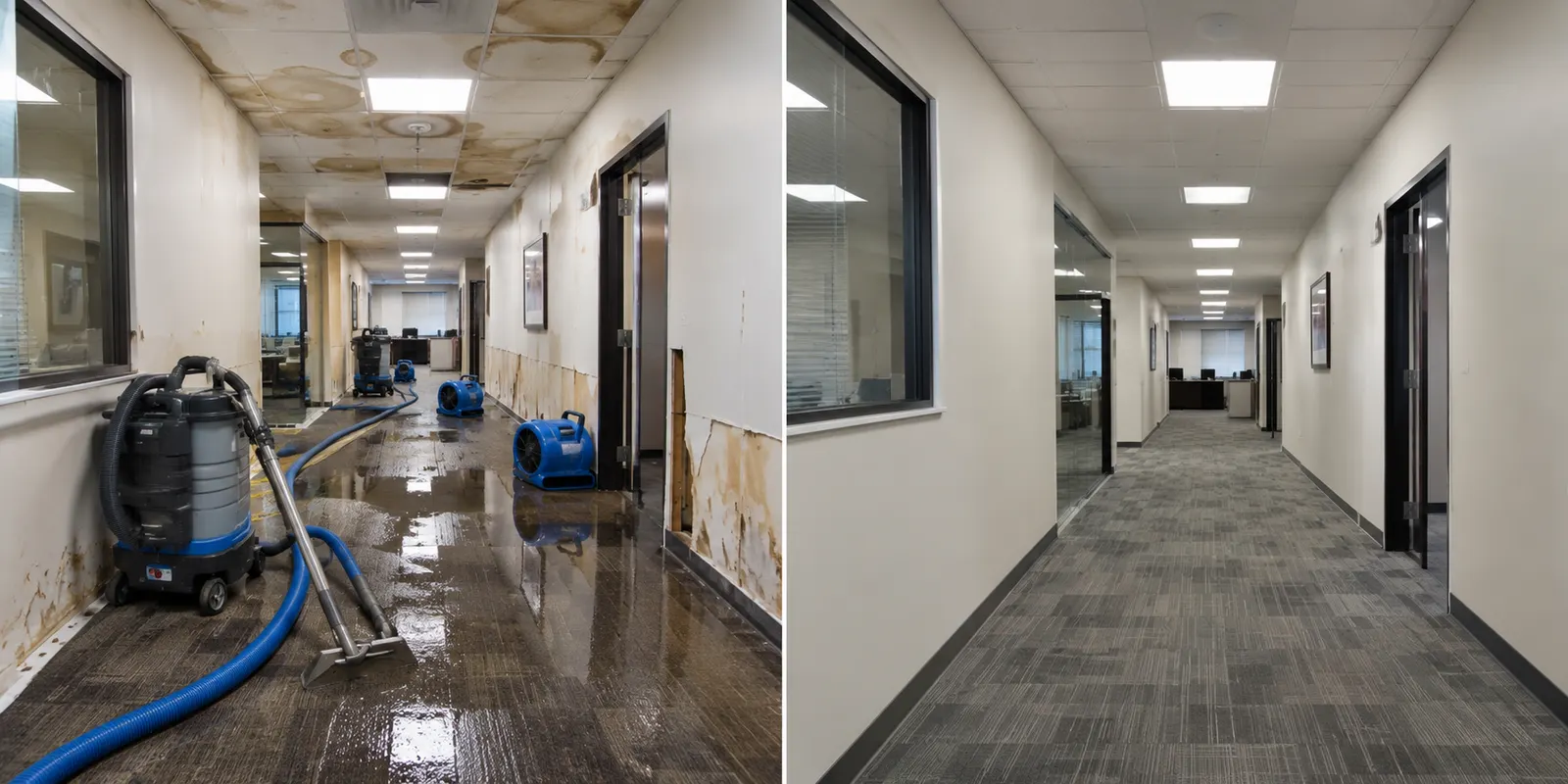
| Office | Ceiling plenums, carpet tile over slab, partition bases, cable chases. | Servers and records, shared HVAC, suites below, lease responsibility. |
| Retail unit | Open floor, stock on the floor, party walls to the next tenant. | Stock handling and customer-facing hours. |
| Restaurant | Floor drains, kitchen and grease lines, walk-in coolers and refrigeration. | Food safety and health-department requirements; drain or grease sources are handled differently from clean water. |
| Warehouse | Large slab, pallets and racking bases, dock doors, roof drains. | Inventory, powered equipment near water, the sheer volume to dry. |
Landlords, tenants and neighbors
In multi-tenant buildings the source is often in another space. A leak upstairs saturates the ceiling plenum below, and the corridor can carry water to a third suite. The result is that work has to be authorized and scheduled with the owner or manager, and each tenant may need to be told, give access or sign off on its own space.
- Get one named contact at management, and give them one on your side.
- Photograph each affected tenant space and the common areas before work begins.
- Agree who authorizes work in common areas, shared chases and ceilings above tenant spaces.
- Record the time the loss was discovered and the time the water was shut off.
- Ask what vendor paperwork the building requires, such as proof of insurance, so work is not held up at the door.
The Addison page has a notification sequence for multi-story buildings that applies to most commercial districts.
Equipment in occupied space
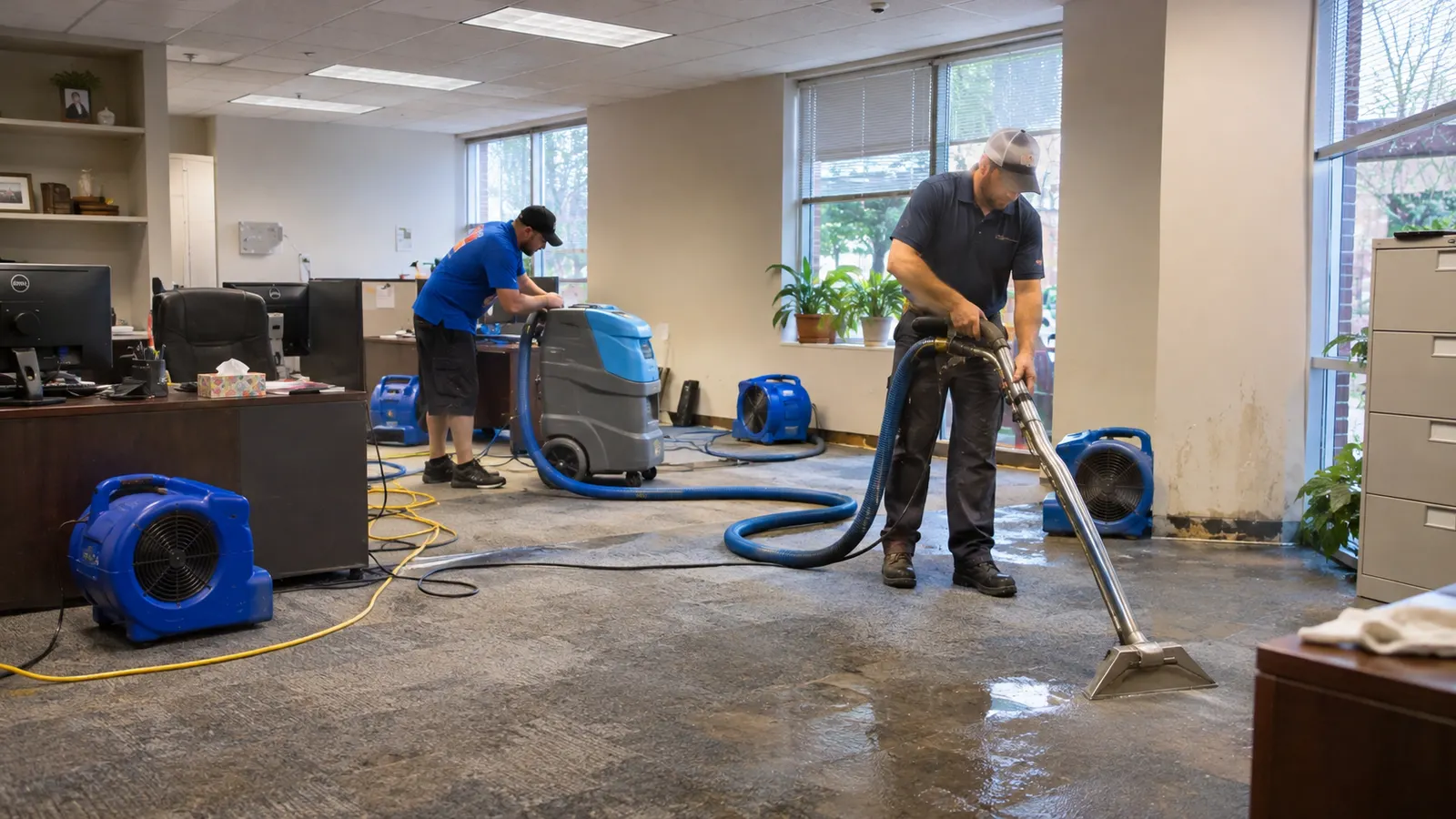
Air movers and dehumidifiers need power and floor space. In occupied space that means cord routes that are not trip hazards, equipment that stays out of aisles and exits, circuits that will not overload, and attention to noise. Dehumidifiers give off heat, which matters in small server rooms and cooler spaces, so the plan accounts for HVAC. Placement is adjusted as readings fall, and equipment that is no longer helping comes out, which reduces disruption.
Documentation for insurers and landlords
Insurers handling commercial claims ask about the cause, the affected square footage, the inventory and equipment affected and the timeline. List the affected rooms and contents, photograph them in place, and keep copies of the moisture logs. If business interruption coverage may apply, ask your agent early what it needs to see. Coverage is the insurer’s decision, not the restoration company’s.
Reopening decisions
Reopening depends on more than visible dryness: materials and cavities verified dry, any mold-related concerns dealt with, electrical and fire protection systems safe and operable, no remaining odor or contamination, and whatever the regulator or landlord requires. Partial reopening can work when a dry section is separated from an active drying zone. If dampness lingers, read mold removal and use the assessment tool to describe it before you call.
Other commercial causes have their own pages: flood damage, sewage backups and roof leaks.
What this page does not claim
It describes the process, not past projects. No customer names, certifications or completed jobs are listed because none have been verified for publication. If a lease or contract requires proof of credentials or insurance, ask for it directly when you call.
Frequently asked questions
We are a tenant. Who do we call first?
Shut off water to your space if you can, then notify building management right away. The lease usually decides who authorizes work and who is responsible for which parts of the space. Photograph your own area before anything is moved.
Can we stay open while drying equipment runs?
Sometimes, if the wet area can be isolated and nothing hazardous is exposed. Noise, airflow, cords on the floor and electrical safety all matter, and food service has regulatory limits. It is decided after inspection.
How do we limit disruption to staff and customers?
Ask for a plan that names the equipment placement, the monitoring visits and the criteria for removing equipment, and give one person on your side authority to coordinate access.
Does cleanup include rebuilding finishes?
Restoration covers extraction, drying and removal of unsalvageable materials. Reconstruction, such as new ceiling tile, drywall and flooring, is a separate scope that should be agreed in writing.
Does the building’s vendor paperwork matter?
Property managers often require vendors to provide proof of insurance and sometimes a certificate naming the owner before work starts in a building. Ask the manager what they require so work is not held up at the door.
Tell us the property type, how many spaces are wet and who manages the building.