
Where Farmers Branch is and how it grew
The Handbook of Texas places Farmers Branch on Interstate 35 and State Highway 77, twelve miles north of downtown Dallas, in northwestern Dallas County. Settlers had established a community called Mustang Branch by 1843, named for the mustang grapes along the creek; the name later changed to Farmers Branch because of the area’s farmland. The city incorporated in April 1946 and received a home-rule charter in 1956. Its population table runs from 915 in 1950 to 13,441 in 1960 and 27,492 in 1970, then stays roughly in the 24,000–29,000 range for decades before the 2020 Census count of 35,991.
That growth curve explains the housing. A rapid mid-century build-out produced one generation of buildings, a long plateau produced few new ones, and the last decade or so brought another wave. The census data below confirms that two-era pattern.
What the census says about the buildings in Farmers Branch
The American Community Survey (2024 five-year estimates) counts 17,260 housing units in Farmers Branch with a median year built of 2001. The median hides the shape: roughly 30 percent of units were built in the 1950s and 1960s, and about 40 percent were built in the 2010s or later. Only a small share dates from the 1990s.
measuredHousing units by decade built in Farmers Branch
17,260 housing units; median year built 2001. Two peaks: mid-century and the 2010s. Largest bar in red.
Structure type matters as much as age here. About 42% of units are single-family detached houses, and about 32% are in buildings with 50 or more units. Around 58%of occupied units are renter-occupied. The census data does not say which decade the large apartment buildings come from; do not infer that from the charts alone.
schematicHow building type changes the cleanup
General comparison, not a survey of Farmers Branch buildings.
| Type | Typical water path | Common complication |
|---|---|---|
| Single-family house | Supply line or appliance leak into floors, wall cavities and ceilings below attics. | Hidden wetting behind cabinets and under flooring. |
| Apartment building (50+ units in the data) | Leak in one unit travels through floors, shared walls, ceilings and chases. | Several residents, a manager and often a separate owner’s insurer. |
| Retail strip | Roof leak or supply failure crossing party walls. | Neighboring tenants; stock and fixtures. |
| Office | Ceiling plenum and riser leaks; carpet tile over slab. | Servers, records, shared HVAC; lease responsibility. |
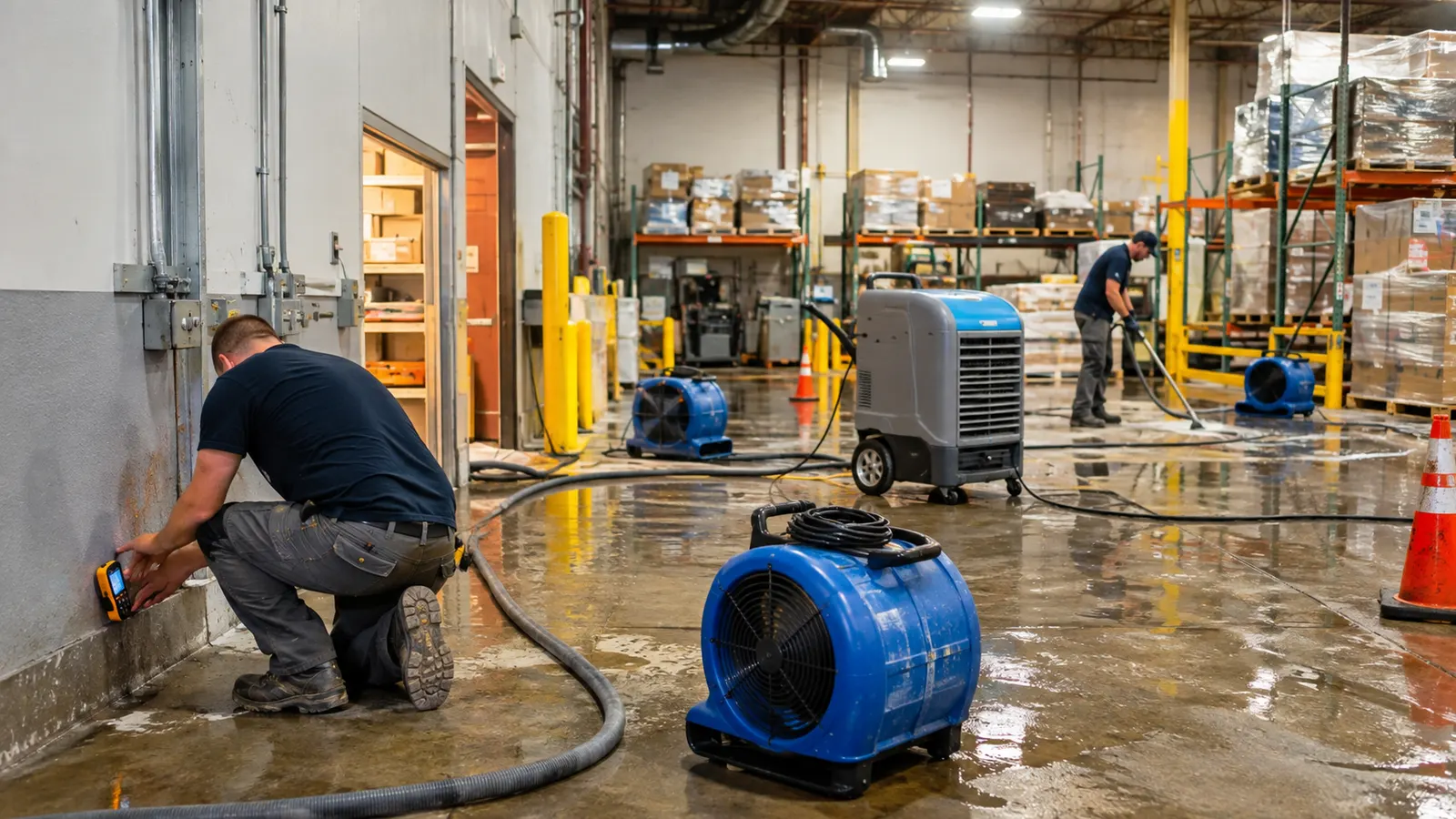
| Warehouse / light industrial | Roof drain failures, sprinkler lines, dock doors; large open slab. | Racking, pallets and inventory; large volume to dry. |
Our water damage restoration process in Farmers Branch, from water extraction to basement drying
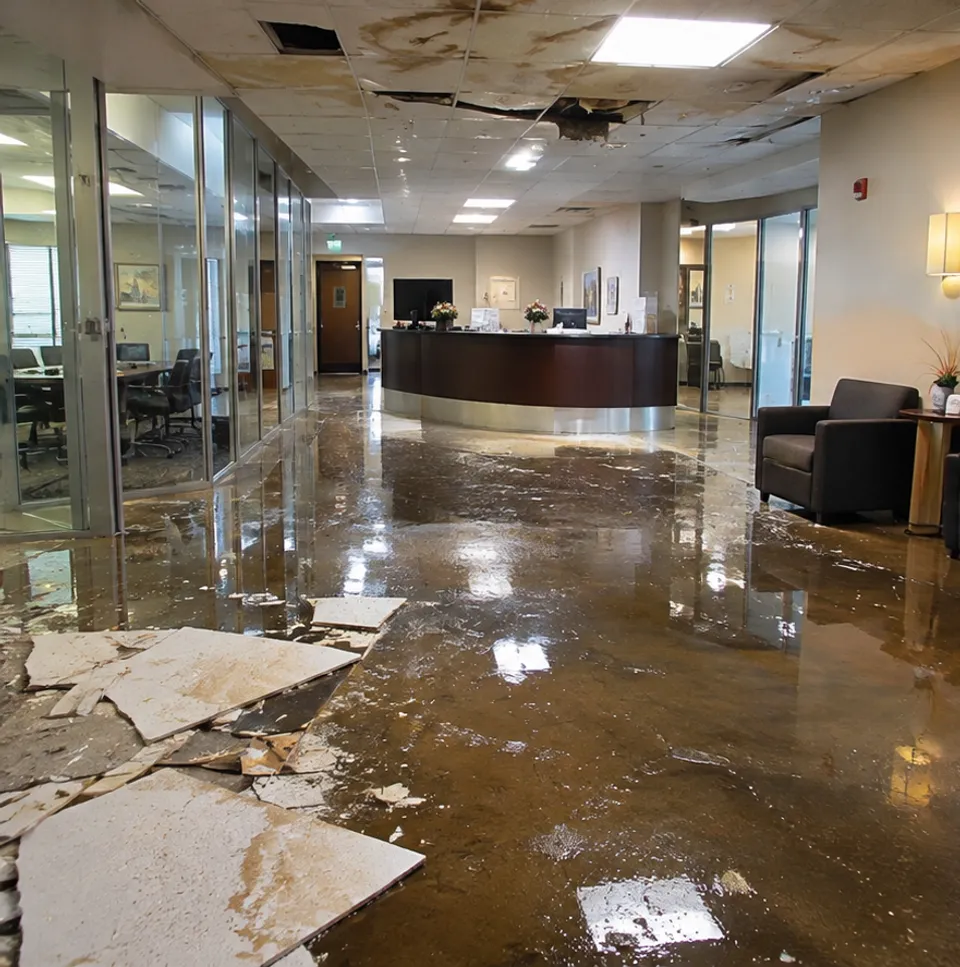
Flood Damage Cleanup
Pump-out, removal of soaked materials and structural drying after heavy rain or storm water enters a property.

Sewage Backup Cleanup
Contaminated water removal, material disposal and sanitizing after a drain or sewer line backs up.
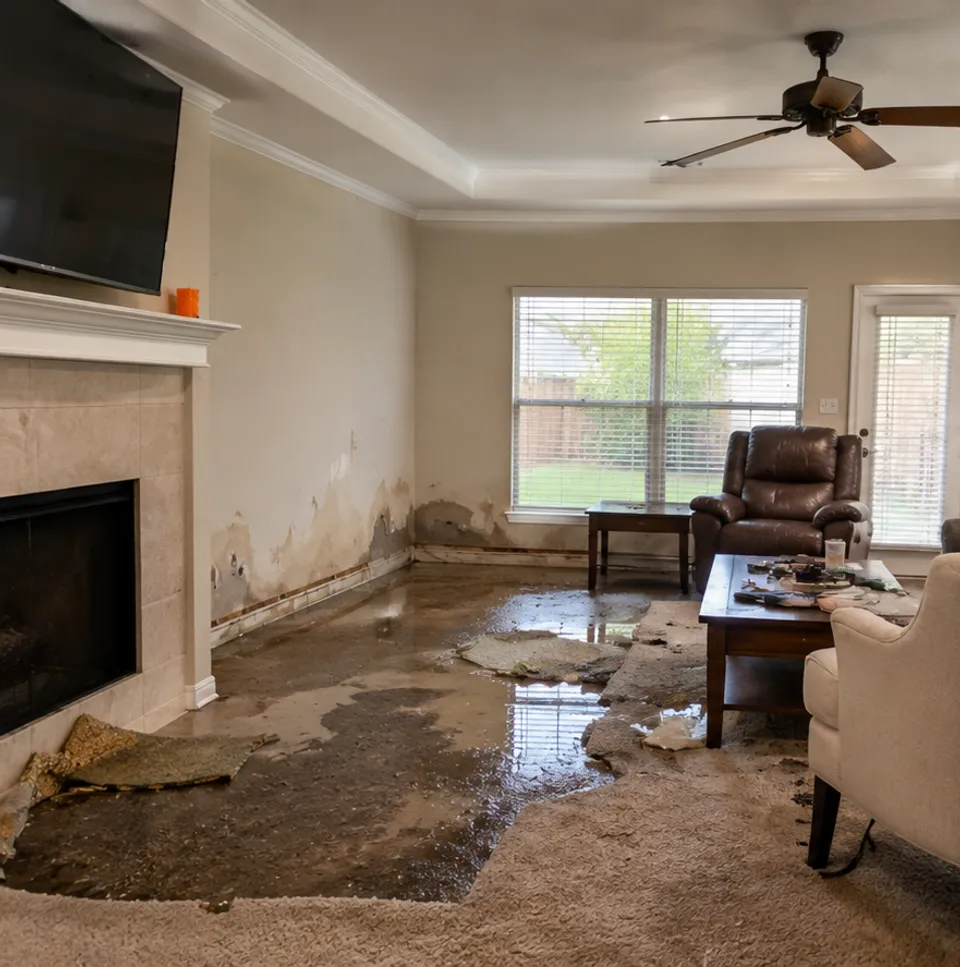
Water Heater and Appliance Leaks
Water extraction and drying after a water heater, washing machine, dishwasher or ice maker leak.
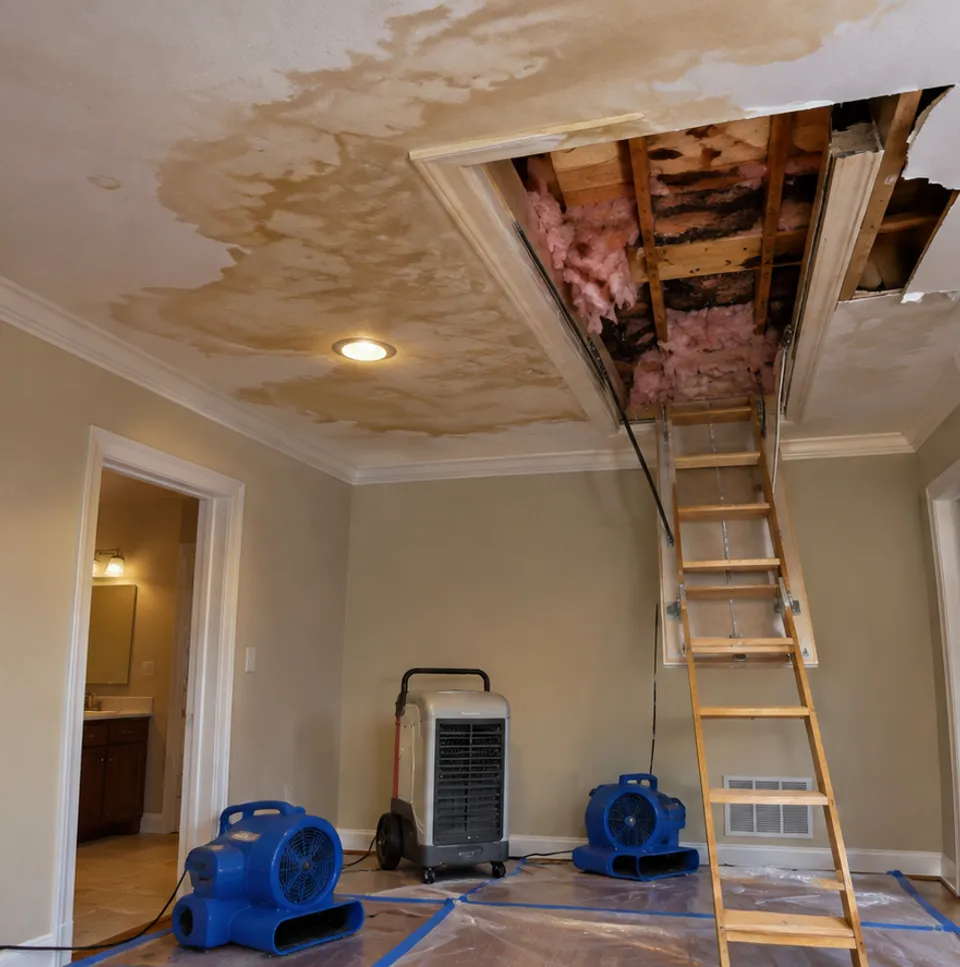
Roof Leak Water Damage
Interior cleanup of wet ceilings, insulation and walls after storm or wind-driven rain gets through the roof.
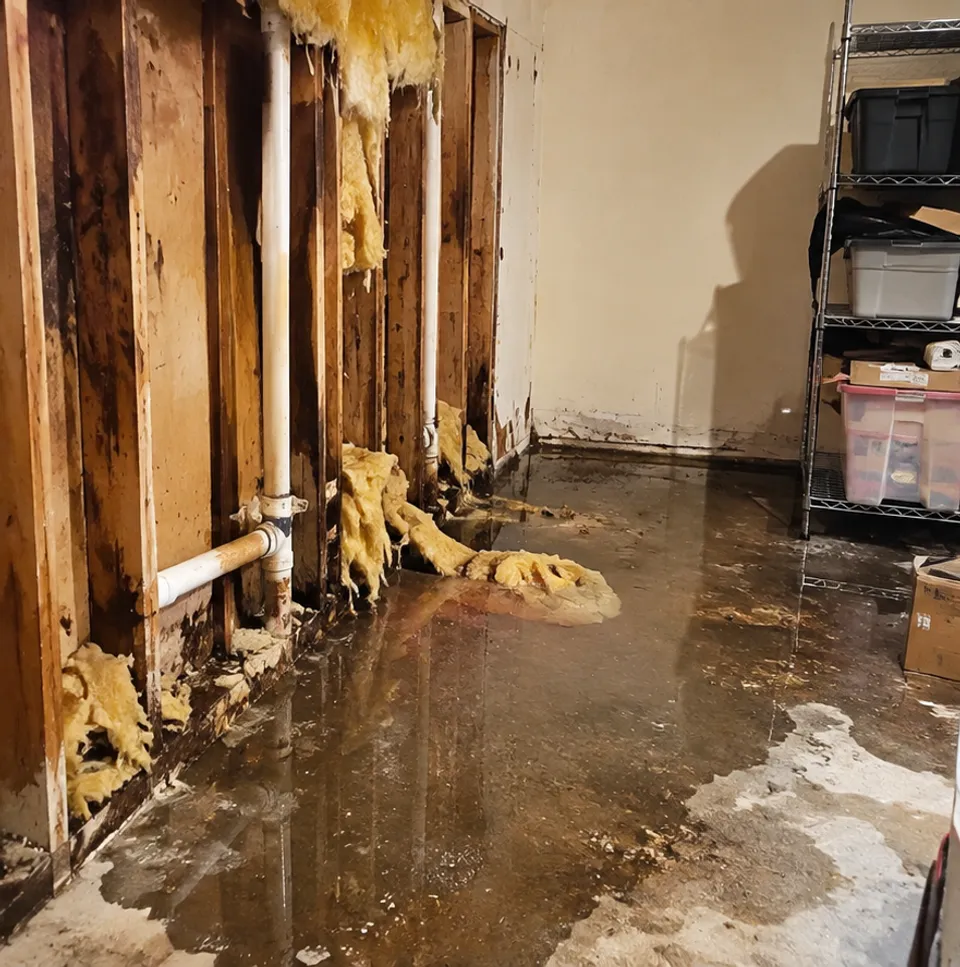
Frozen and Burst Pipe Cleanup
Extraction and deep drying of flooded rooms, ceilings and wall cavities after a plumbing line ruptures.
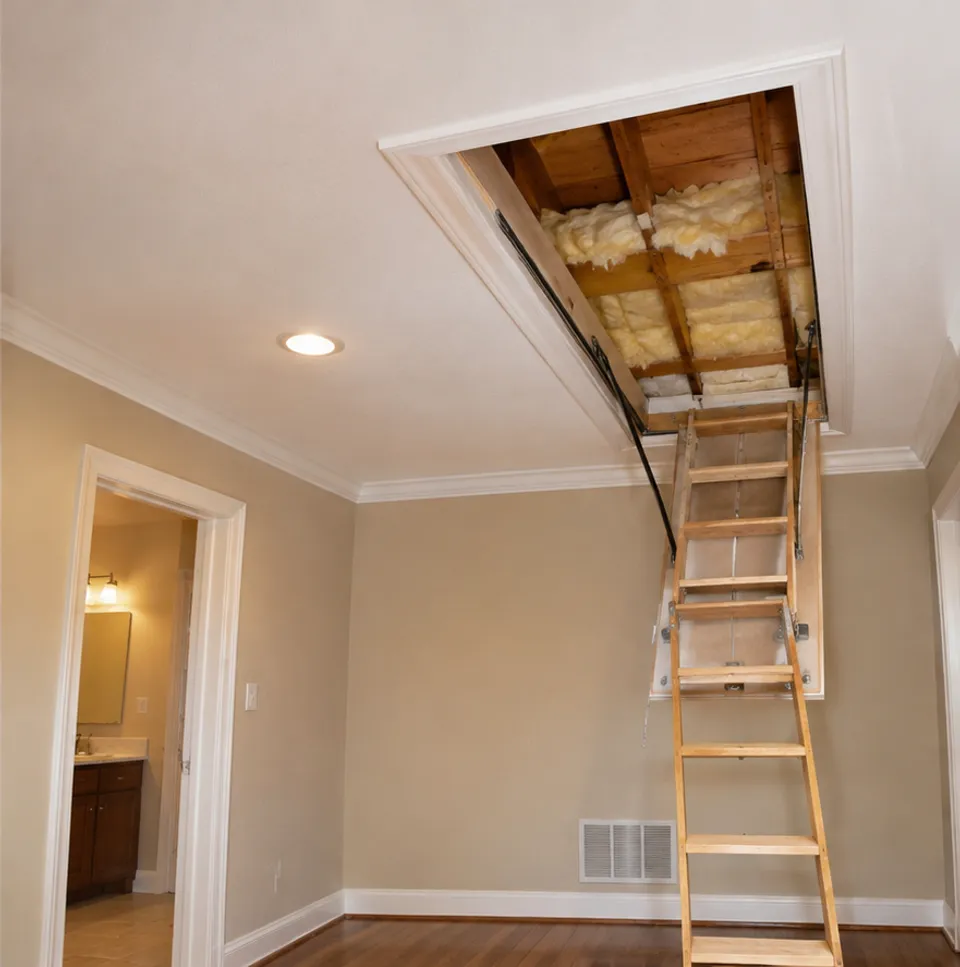
Winter Ceiling and Attic Water Damage
Wet insulation, sagging ceilings and hidden attic moisture after winter leaks.
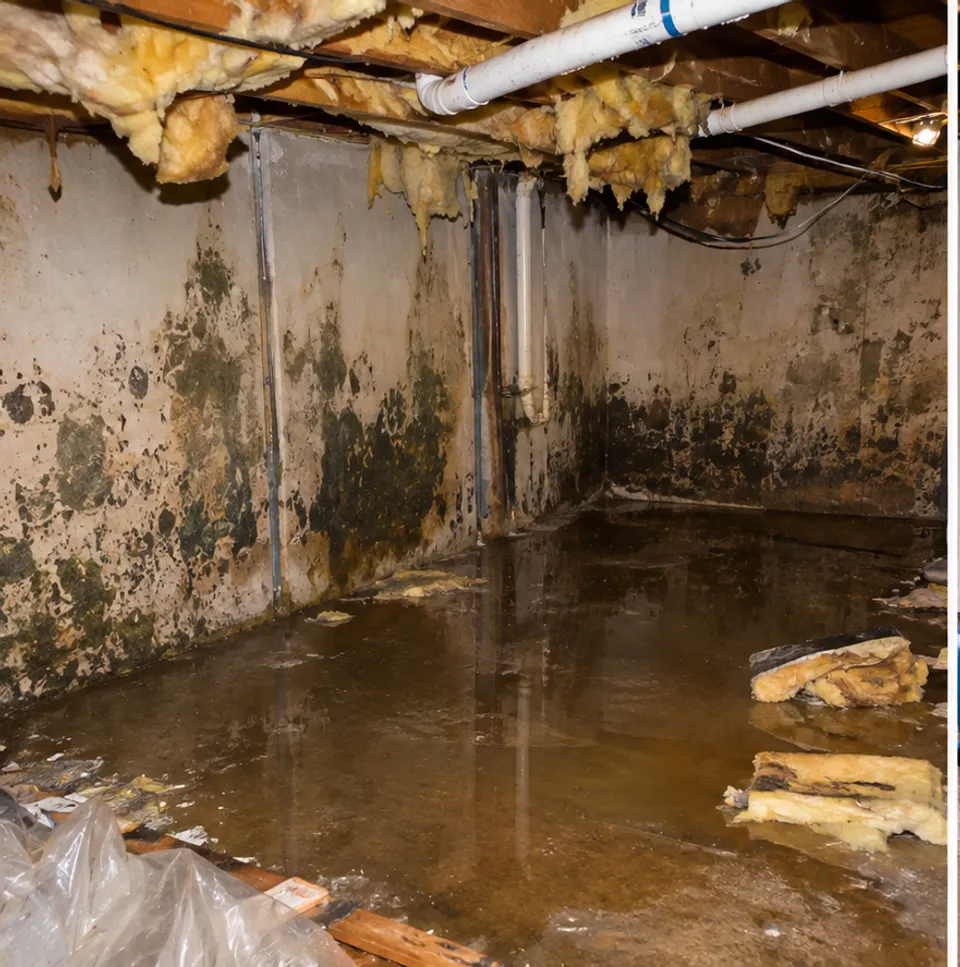
Basement Flooding After Snowmelt
Low-level water cleanup in basements, garages and below-grade rooms when melting snow or rain gets in.
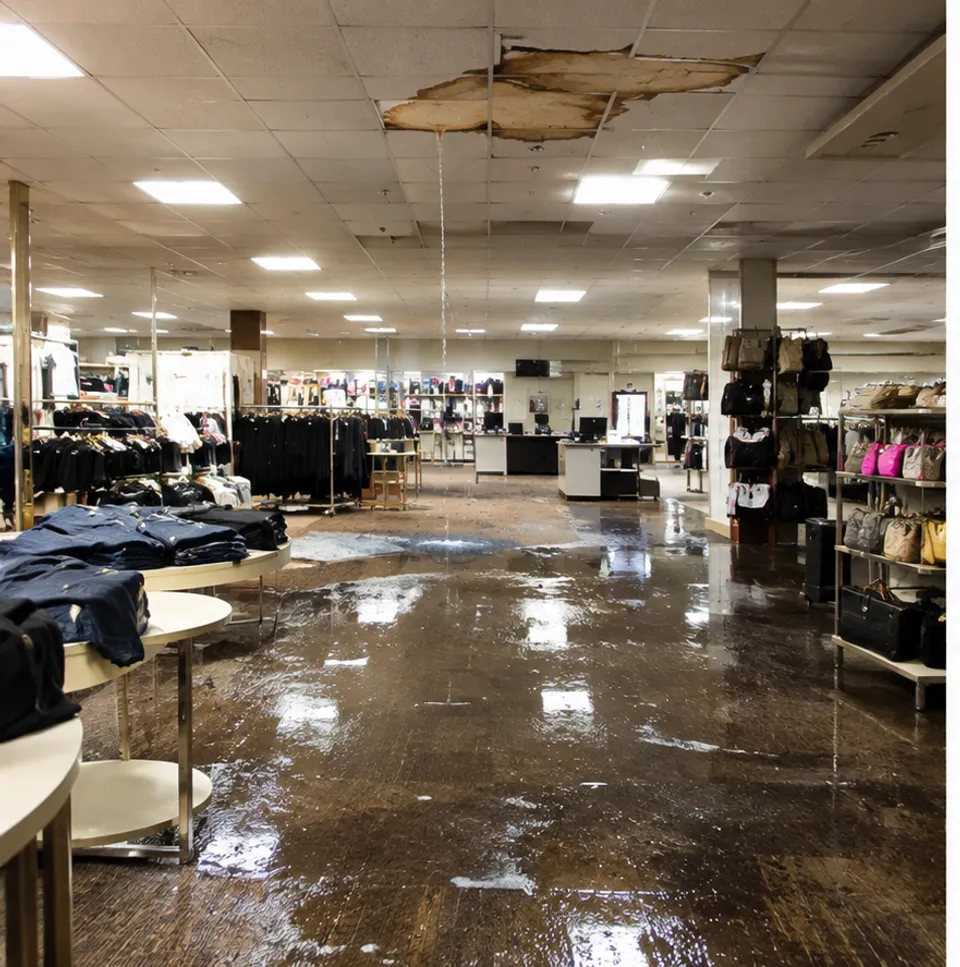
Ice Dam Roof Leak Cleanup
Interior drying and insulation removal after ice at the roof edge forces water inside.
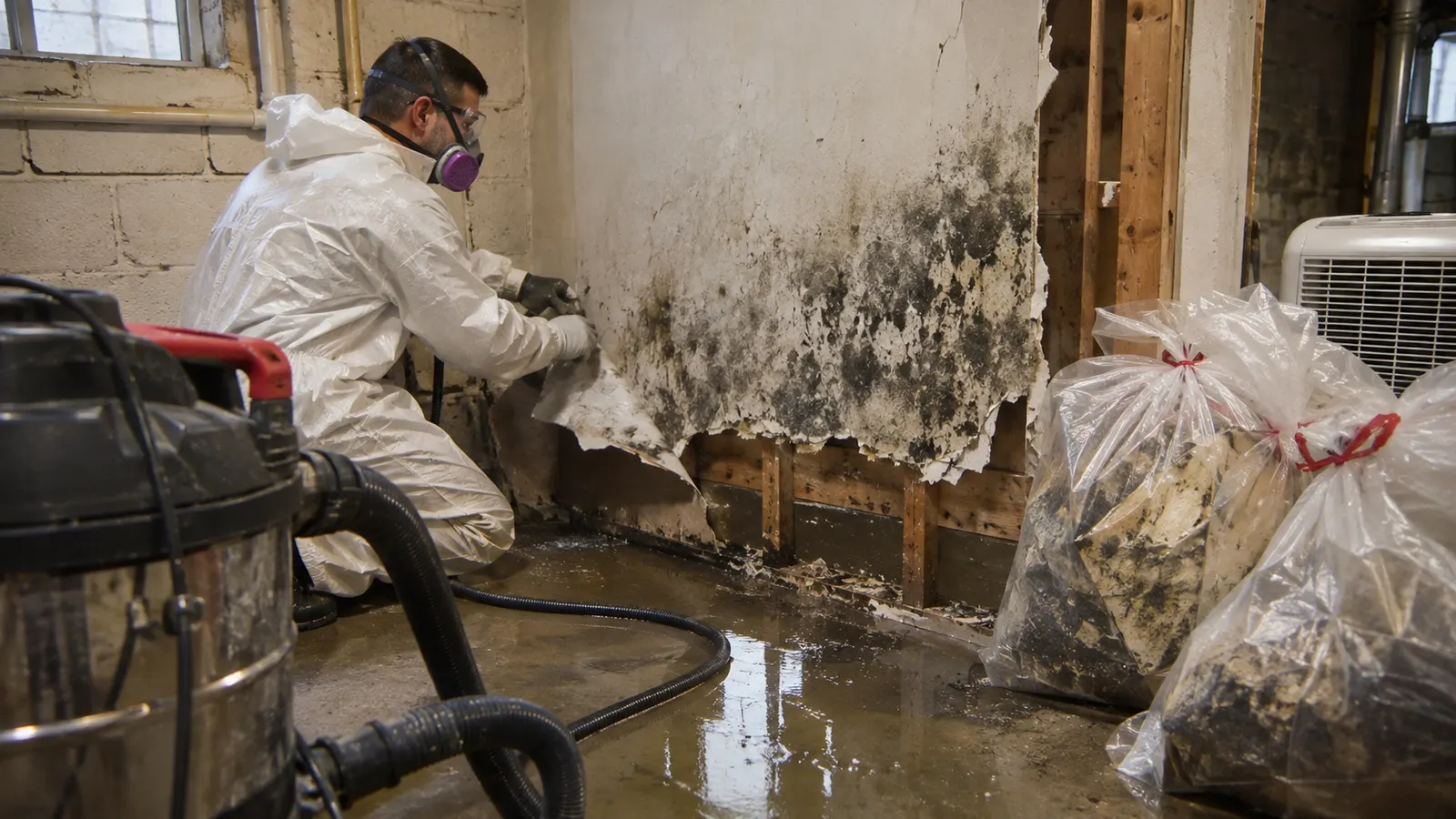
Mold Removal
Moisture-source correction, containment and removal of mold-affected materials after water damage.
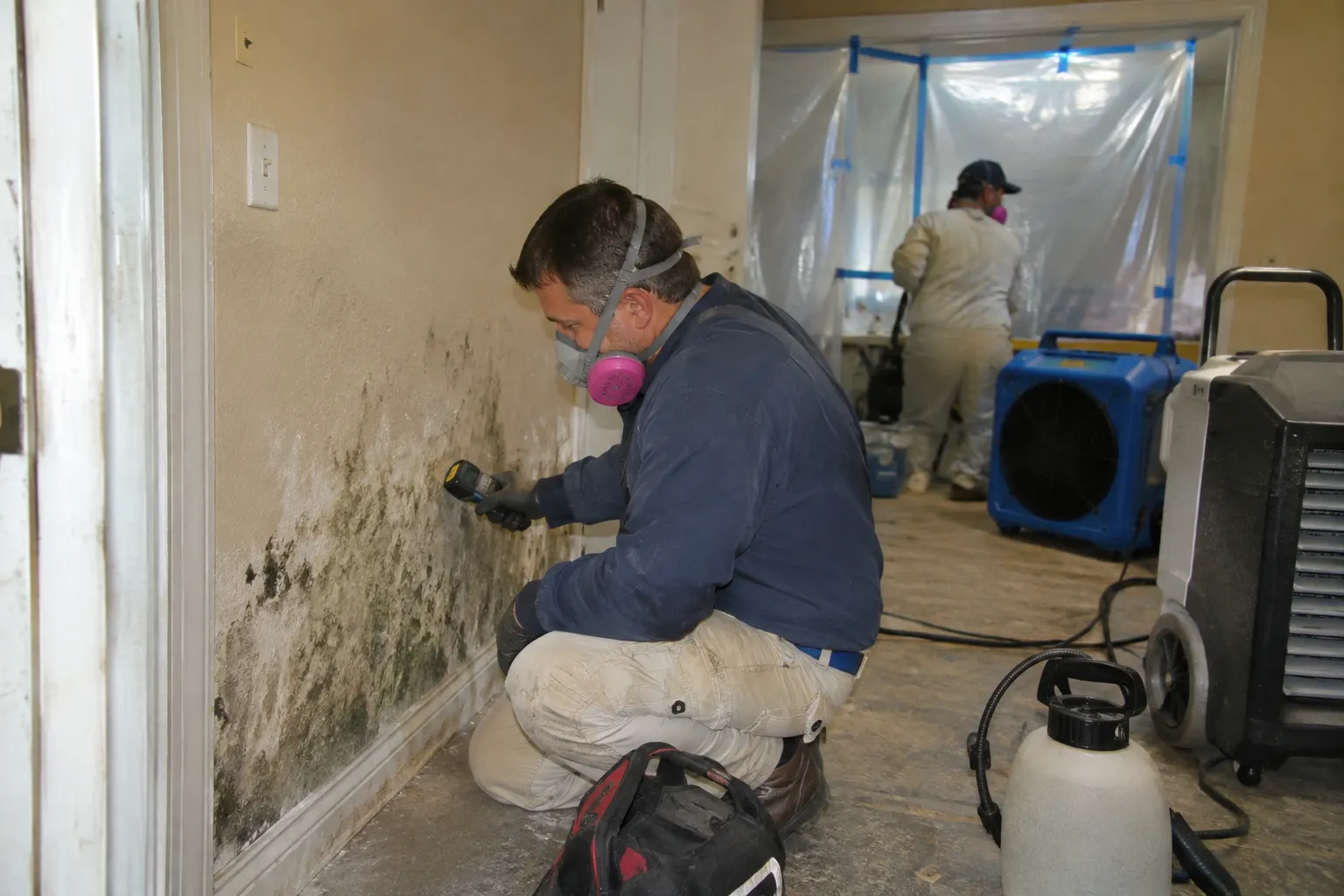
Attic and Crawlspace Mold
Assessment and removal planning for mold in attics, crawlspaces and other concealed, poorly ventilated areas.
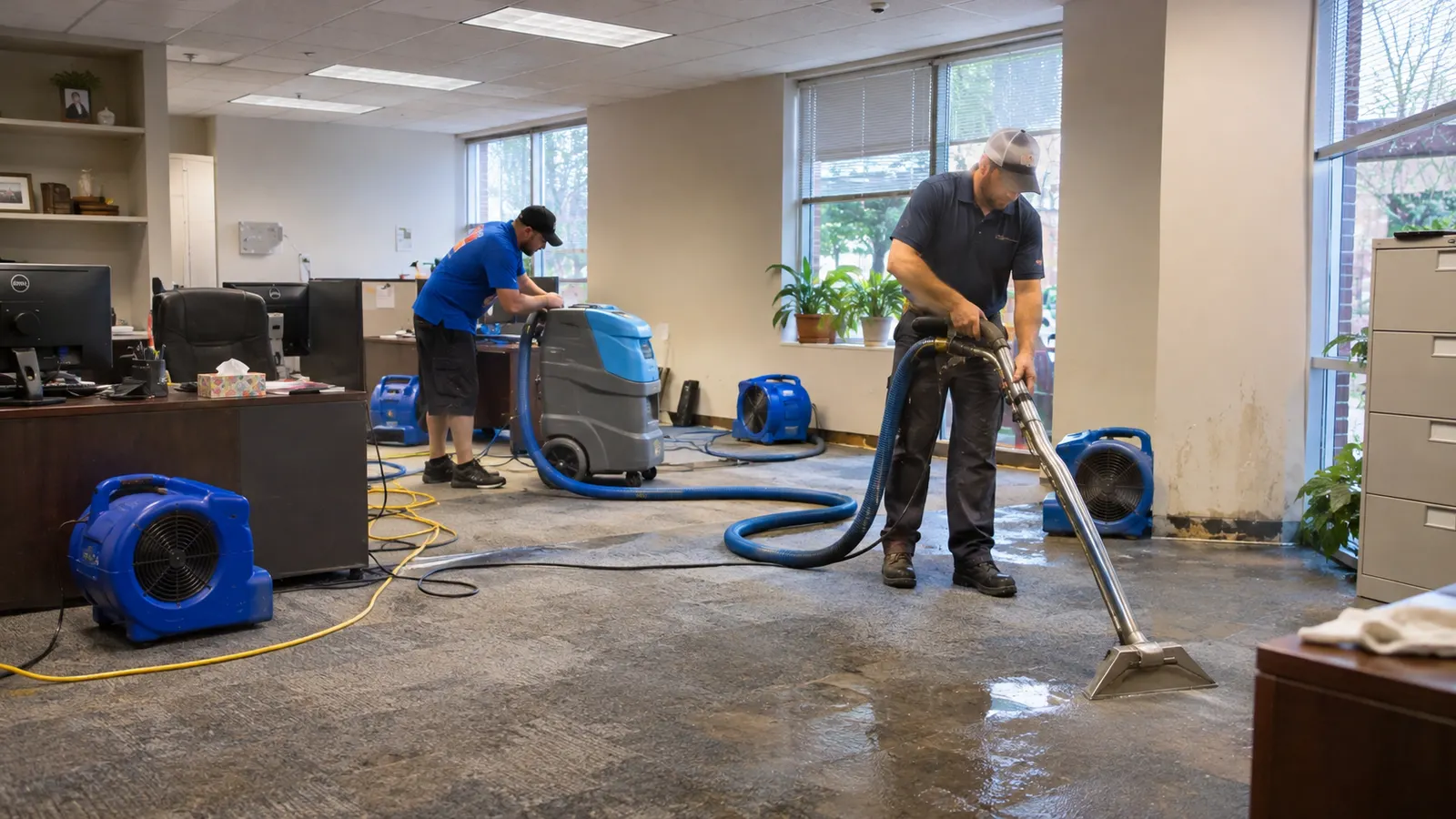
Commercial Water Damage Restoration
Water extraction, drying and tenant coordination for offices, retail units, restaurants and multi-tenant buildings.
A seamless water damage restoration process in Farmers Branch, for your peace of mind
Call and describe the water
Tell us where it is and what it came from. You get safety steps for the next few minutes.
Inspect and map the moisture
Meters and thermal imaging show where the water went, including behind walls and under floors.
Extract and remove what cannot dry
Standing water comes out first. Saturated materials are removed, and you are told which and why.
Dry with recorded readings
Air movers and dehumidifiers run, and readings are tracked so you can see the building drying.
Verify and document
Equipment leaves when readings match dry materials. You keep the readings and photos for your records.
Say what kind of building it is and how many rooms or units are wet.
Mid-century houses and apartments in Farmers Branch
Buildings from the 1950s and 1960s are 55 to 75 years old. At that age, original materials have usually been replaced in part, and what a technician finds behind a wall varies from house to house: older supply or drain materials, additions with different framing, layers of flooring over original subfloors. Water under flooring in an older house is more likely to need the flooring lifted to dry the layers, and older plaster or textured ceilings behave differently from modern gypsum board. None of this can be assumed from the address; it is checked on site.
Newer multifamily and mixed-use buildings in Farmers Branch
Buildings from the 2010s onward are typically larger and more compartmentalized: several floors, shared risers, fire-rated assemblies and sprinkler systems. A leak in one unit may require shutting off a riser serving many units, which only the manager or building engineer can do. Fire sprinkler lines are serviced by a qualified fire protection contractor, and restoration crews coordinate rather than touch them. The notification order on the Addison page applies equally here.
Commercial and industrial properties in Farmers Branch
The city’s website points to extensive commercial and industrial planning districts, including the Mercer Crossing public improvement district and station-area and IH-35E corridor studies. This page does not describe their land use. In warehouse and light-industrial buildings the first questions are where the water is, what is on the floor, whether racks or pallets are wicking it, whether electrical equipment is wet, and who approves work, the tenant, the owner or both. Large slabs and tall roofs mean drying is a volume problem. Retail and office tenants face the coordination issues described on the commercial page.
Creeks and drainage in Farmers Branch
The Handbook of Texas ties the city’s name to a creek, and the city’s Public Works section lists a Floodplain & Drainage page with a tab for Farmers Branch Creek, plus Stormwater and Watershed Creek Study pages. Regional context from Town of Addison engineering records and a local news report shows Farmers Branch Creek crossing into Addison, so the area drains toward the same Trinity River system as its neighbors. Those facts place the city in the watershed; they do not say which buildings are exposed. That depends on mapped floodplains, grading and the building’s elevation. For an address, use the FEMA Flood Map Service Center and ask the city’s Public Works staff. A map showing a building outside a zone does not mean a roof drain or a supply line cannot cause a flood.
Winter exposure in Farmers Branch
Plumbing in older commercial buildings and in apartment communities is often run through unheated spaces, and a freeze that stops building heat can lead to several failures at once. Single-family houses are more exposed at attics, exterior walls and garage plumbing. The regional freeze pattern is covered on the frozen pipe pageand the checklist helps after a failure.
Farmers Branch local resources
- City of Farmers Branch, Public Works, engineering, floodplain and drainage, stormwater (farmersbranchtx.gov).
- FEMA Flood Map Service Center, official mapped flood hazard areas.
- National Weather Service Fort Worth, warnings and climate normals.
Water damage restoration work for buildings like those in Farmers Branch
Typical conditions and equipment for the building types discussed on this page. The photos are not tied to a specific address or project.
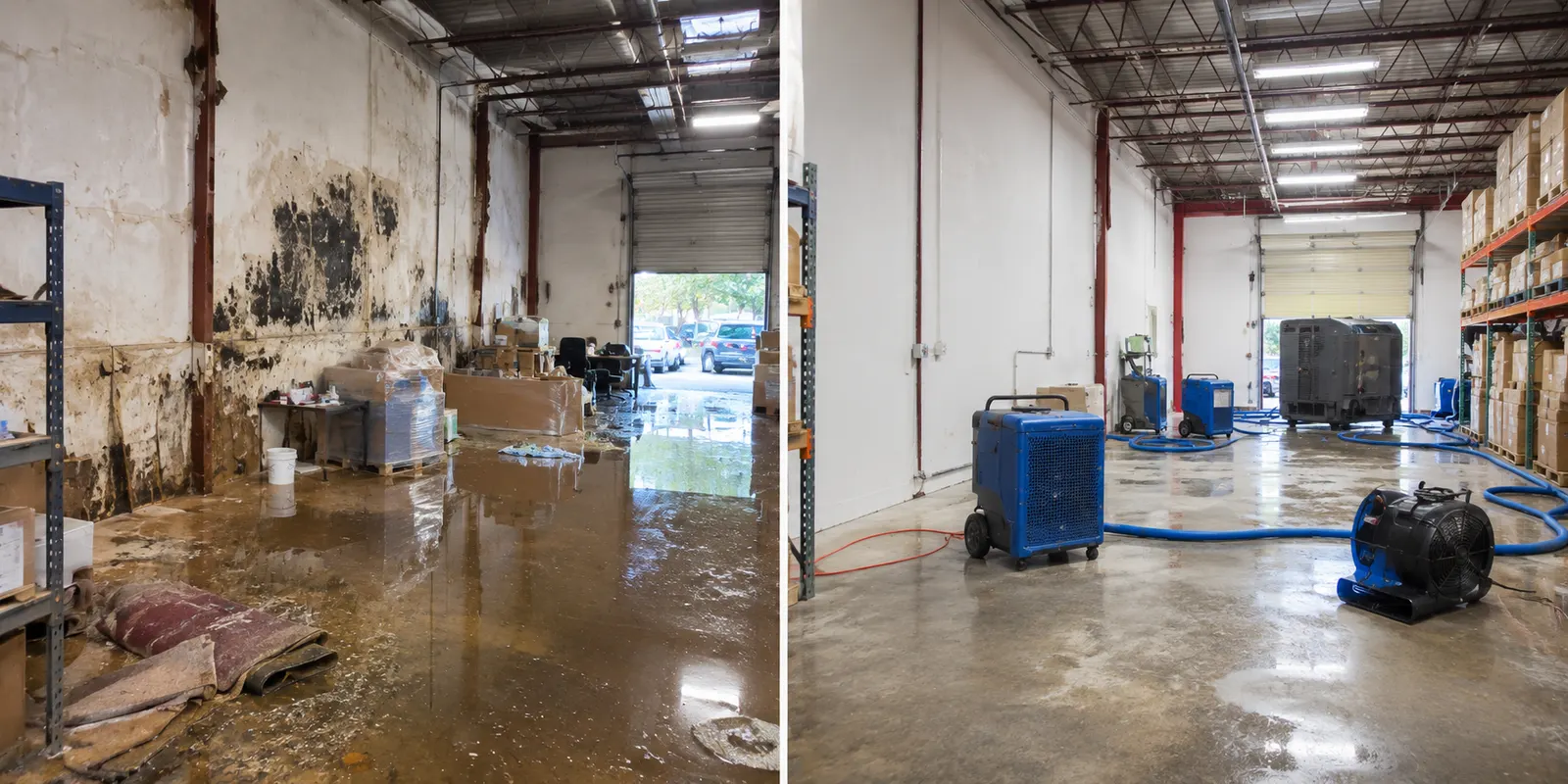
Standing water and damaged goods on a warehouse floor, then the cleared, dry space.
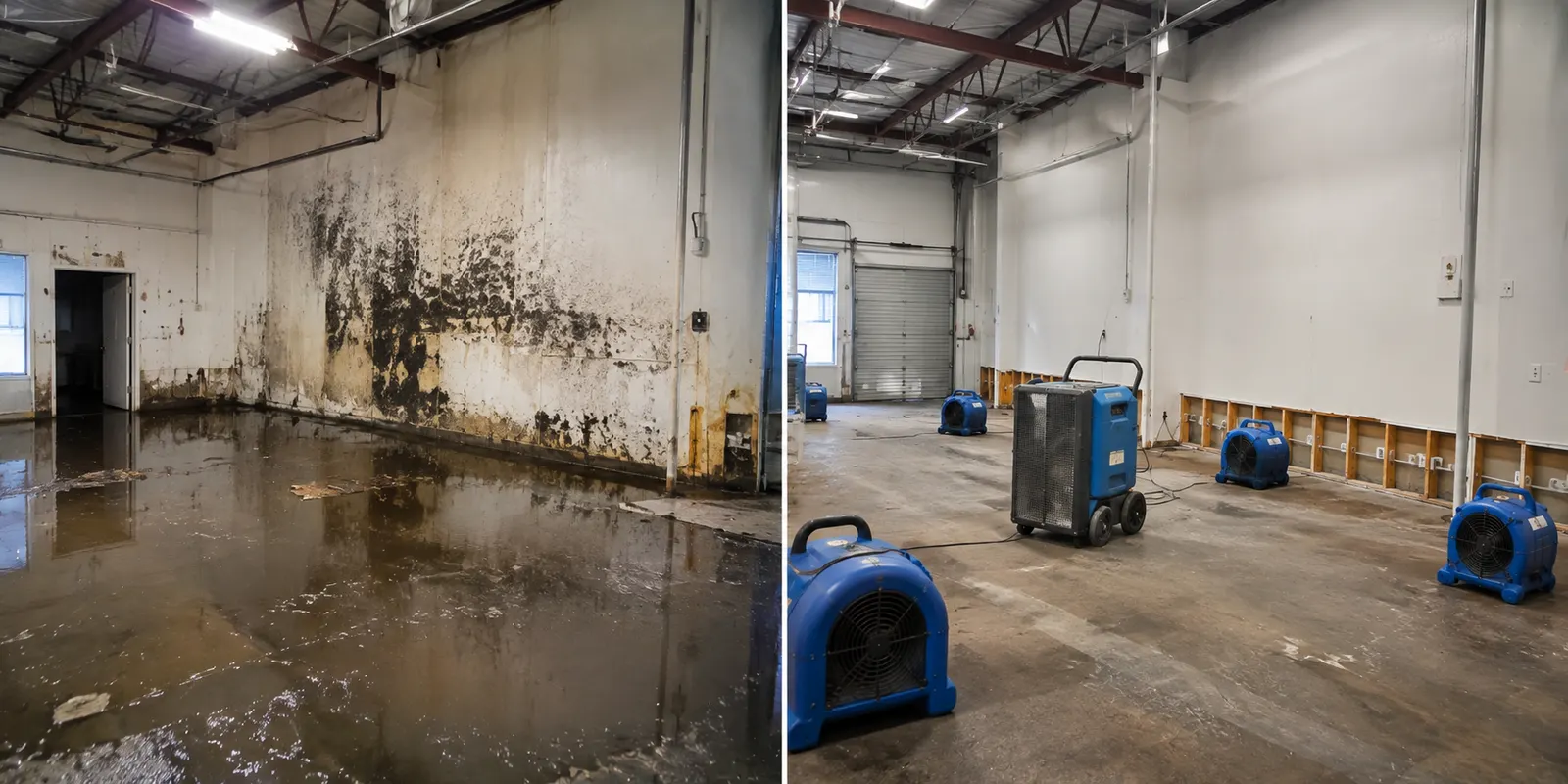
A stained warehouse wall with standing water, then the dry bay with drying equipment.
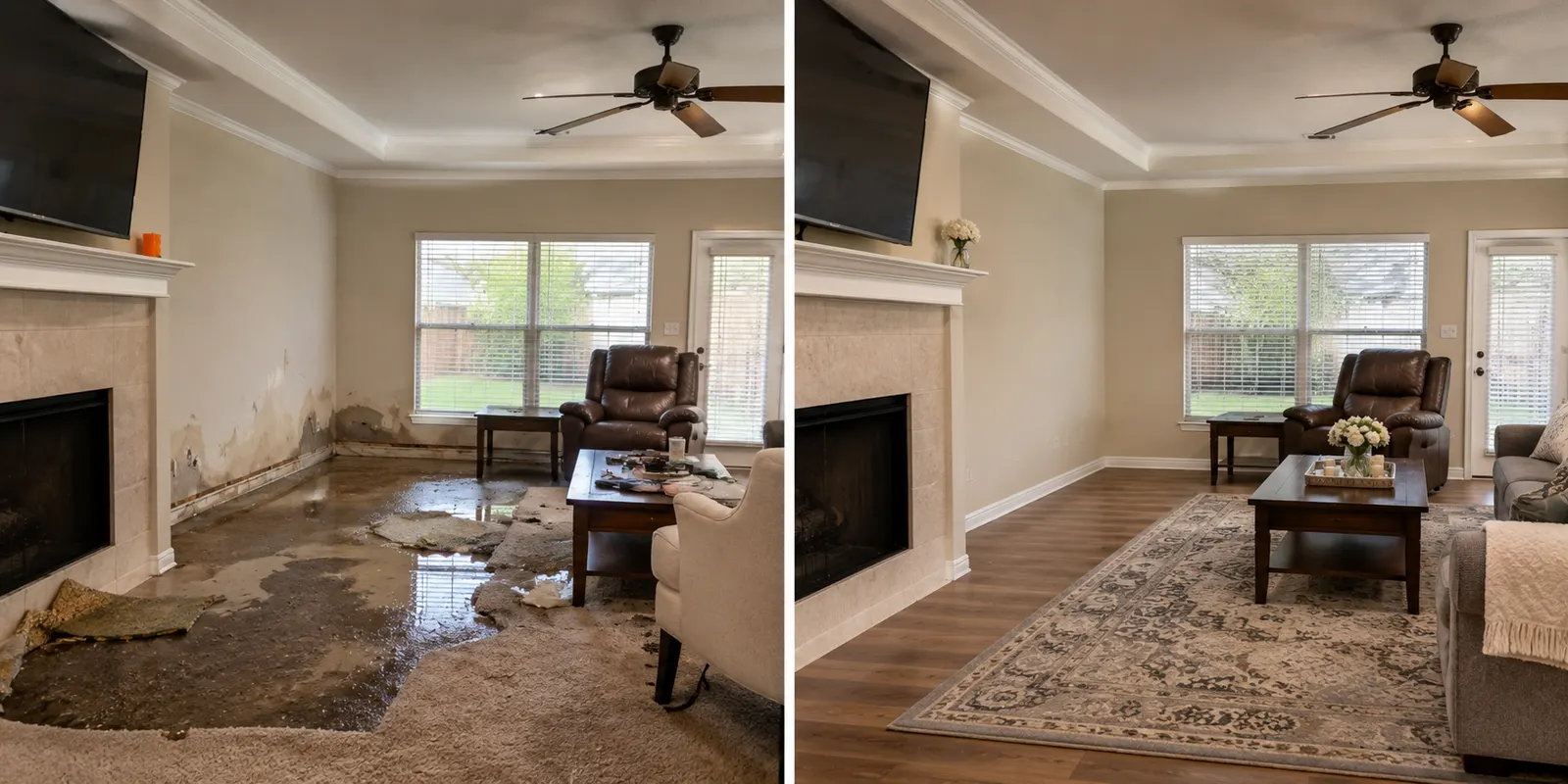
Wet carpet and water-stained walls in a living room, then the restored room with new flooring.
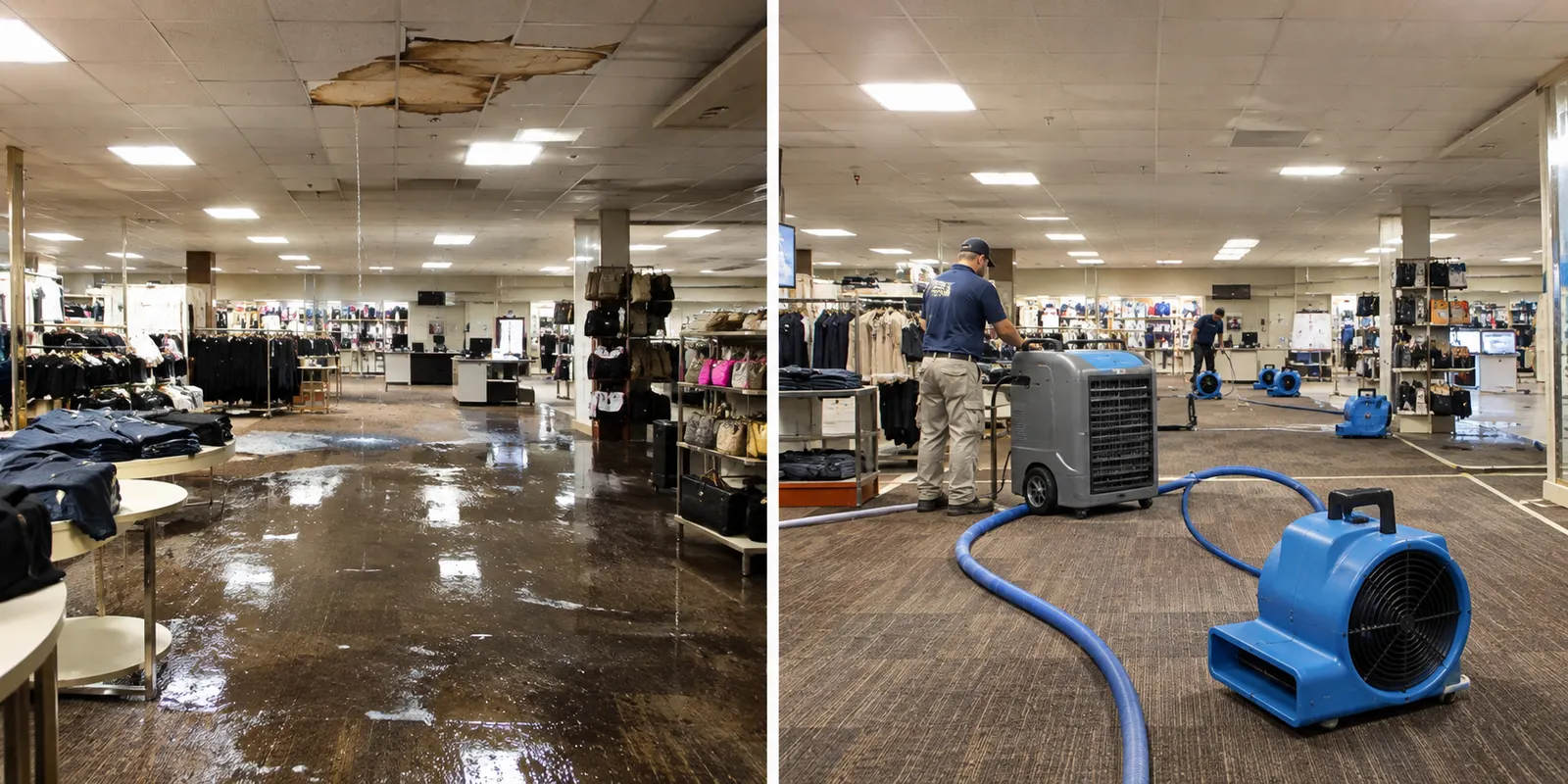
Standing water on a retail floor, then a technician working among dehumidifiers and fans.
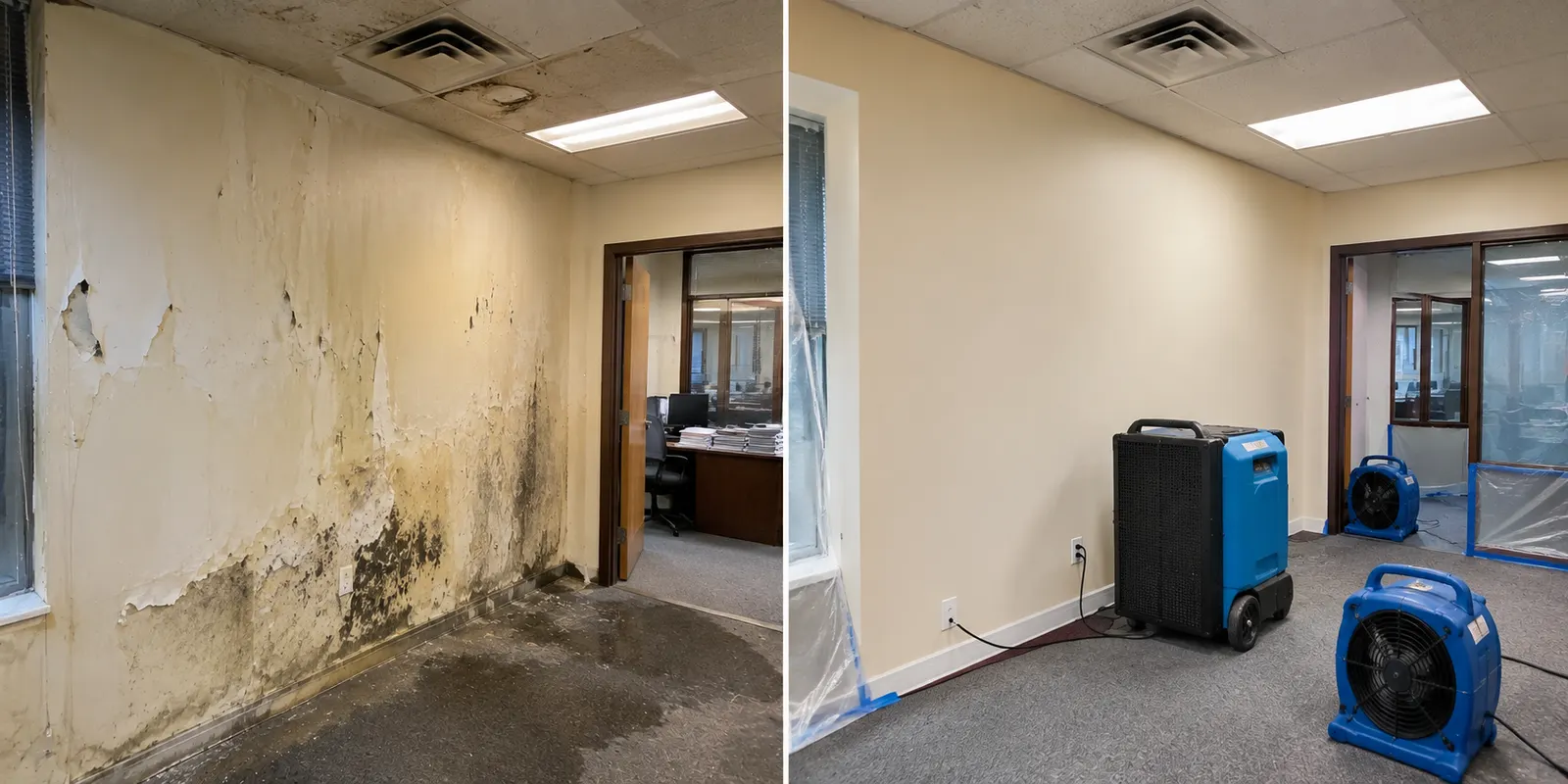
A water-stained office wall, then the cleaned wall with a dehumidifier running.
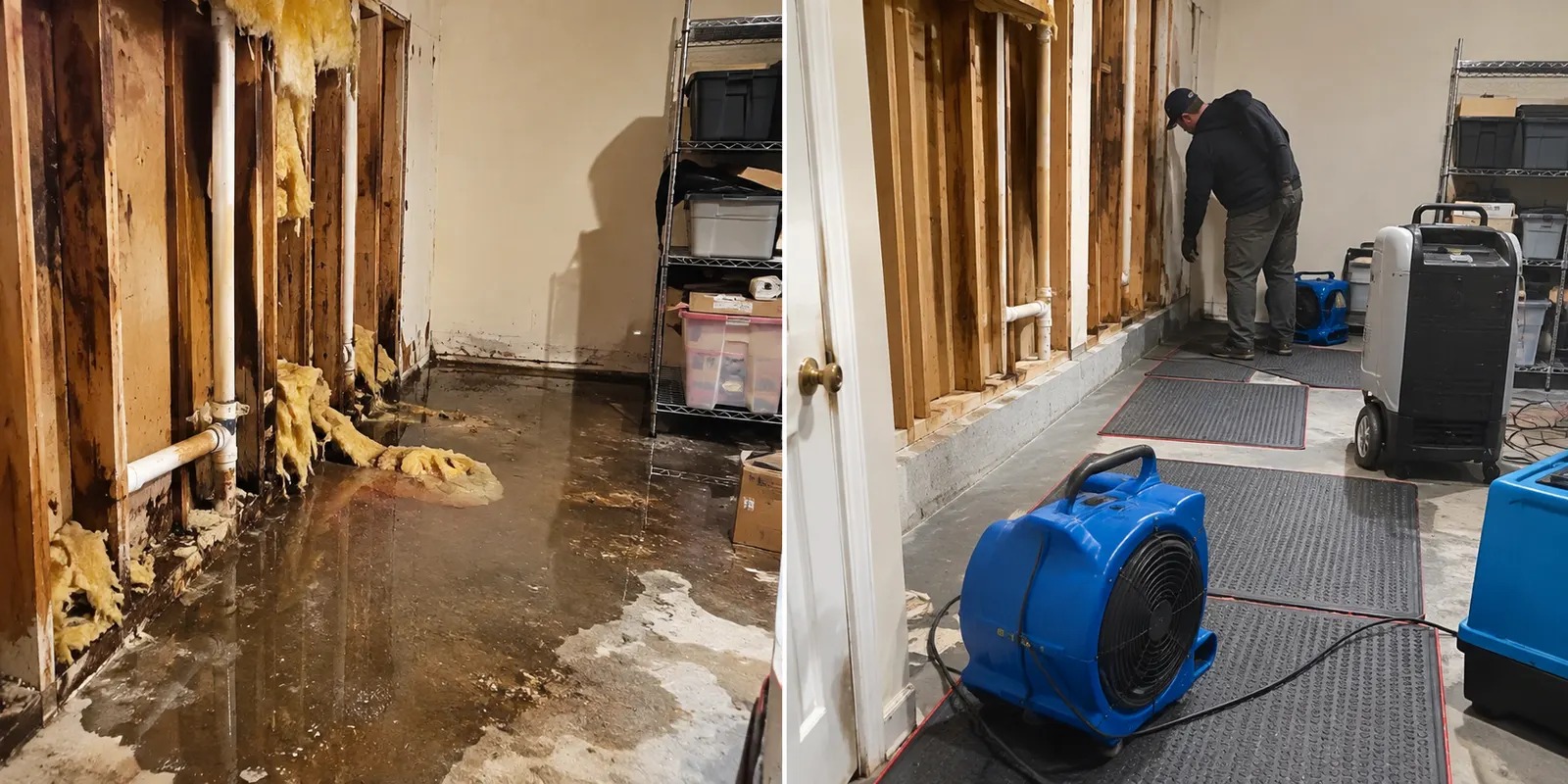
A flooded hallway with stripped walls, then the same space after extraction with a fan on a clean floor.
Water damage questions in Farmers Branch
Does Farmers Branch Creek make my property more likely to flood?
Not by itself. Flood exposure is a mapped, property-specific question. Check the FEMA flood map for the address and ask the city’s floodplain and drainage staff. Creek proximity does not tell you whether a building has taken on water.
We lease a warehouse bay. Who should I notify about a roof leak?
Your landlord or property manager first, because roof and building systems are normally the owner’s responsibility, then your insurer. Photograph stock and equipment before anything is moved.
Is cleanup different in an older single-family house than in a newer one?
The physics are the same. What differs is construction: foundation type, ceiling and wall materials, and plumbing materials, which affect what must be opened and how drying equipment is placed.
Can a leaking pipe in a neighboring unit wet my space?
Yes. In attached and multi-tenant buildings water can cross shared walls, ceilings and chases. Tell the manager and photograph your space before work.
Where does the city publish floodplain information?
The City of Farmers Branch website lists Public Works pages for Floodplain & Drainage, Stormwater and a Watershed Creek Study. Ask city staff directly for current drainage and floodplain information.
Tell us the building type and what is wet.
Source notes
- Handbook of Texas, Farmers Branch, TX, location, naming, incorporation, population table; revised 2023
- City of Farmers Branch, departments and Public Works
- Census Reporter, ACS 2024 5-year tables B25034, B25024, B25003, B25035, Farmers Branch city, housing units by year built, structure type and tenure
- Town of Addison GIS records, Farmers Branch Creek cross section correspondence
- NBC DFW, Farmers Branch and Addison dispute over creek water